

If you’re searching for a clear, practical internet of things overview, you likely want more than buzzwords—you want to understand how connected devices actually work, why they matter, and how they’re transforming industries and everyday life. This article is designed to give you exactly that: a concise yet comprehensive look at the core concepts behind IoT, including sensors, connectivity, data processing, security considerations, and real-world applications.
We break down complex technical ideas into straightforward explanations, drawing on established computing principles, current AI and machine learning integrations, and modern data encryption practices that power today’s connected ecosystems. Whether you’re a student, tech enthusiast, or professional exploring device optimization and smart systems, this guide will help you build a solid foundation and confidently navigate the rapidly evolving world of interconnected technology.
Demystifying the Connected World: A Practical Guide to IoT
The Internet of Things connects sensors, devices, networks, and cloud software to collect, process, and act on data. Sensors gather real-world inputs; gateways transmit them; analytics engines turn raw signals into usable insight. Think smart thermostats optimizing energy or factories predicting equipment failure before breakdowns occur.
However, hype often obscures fundamentals. This internet of things overview clarifies architecture and security, including encryption that protects device-to-cloud traffic. Looking ahead, speculation: edge computing and AI chips will shrink latency and power use, enabling autonomous cities and precision agriculture at global scale. prioritize interoperability.
The Four Pillars of IoT Architecture
An effective Internet of Things (IoT) system rests on four essential pillars. Think of it like a smart city: without roads, utilities, data centers, and control rooms, nothing works in harmony.
1. Sensing & Data Acquisition
This is the foundation. Sensors (devices that detect physical changes like temperature, motion, or pressure) and actuators (components that trigger actions) capture real-world signals and convert them into digital data. For example, a soil moisture sensor in agriculture can trigger irrigation automatically (no farmer running through fields required).
2. Connectivity & Network Infrastructure
Once data is captured, it must travel.
- Wi-Fi: High bandwidth, ideal for smart homes.
- Bluetooth: Short-range, low energy wearables.
- Cellular: Wide coverage for fleet tracking.
- LoRaWAN: Low-power, long-range industrial sensors.
Choosing the wrong network is like streaming Netflix on dial-up (technically possible, painfully impractical). For a broader internet of things overview, see this resource: https://example.com.
3. Data Processing & Analytics
Raw data alone is noise. Cloud computing centralizes massive datasets, while edge computing processes data near the device for faster decisions. AI and machine learning identify patterns—like predictive maintenance in factories. Some argue cloud-only systems are enough. However, edge processing reduces latency and bandwidth costs. Speculation: edge AI chips will dominate industrial IoT within five years as real-time automation expands.
4. User Interface & Application
Dashboards, alerts, and automated triggers turn insights into action. A smart thermostat adjusting itself? That’s pillar four in action (and saving you money quietly).
High-Impact IoT Applications Transforming Industries
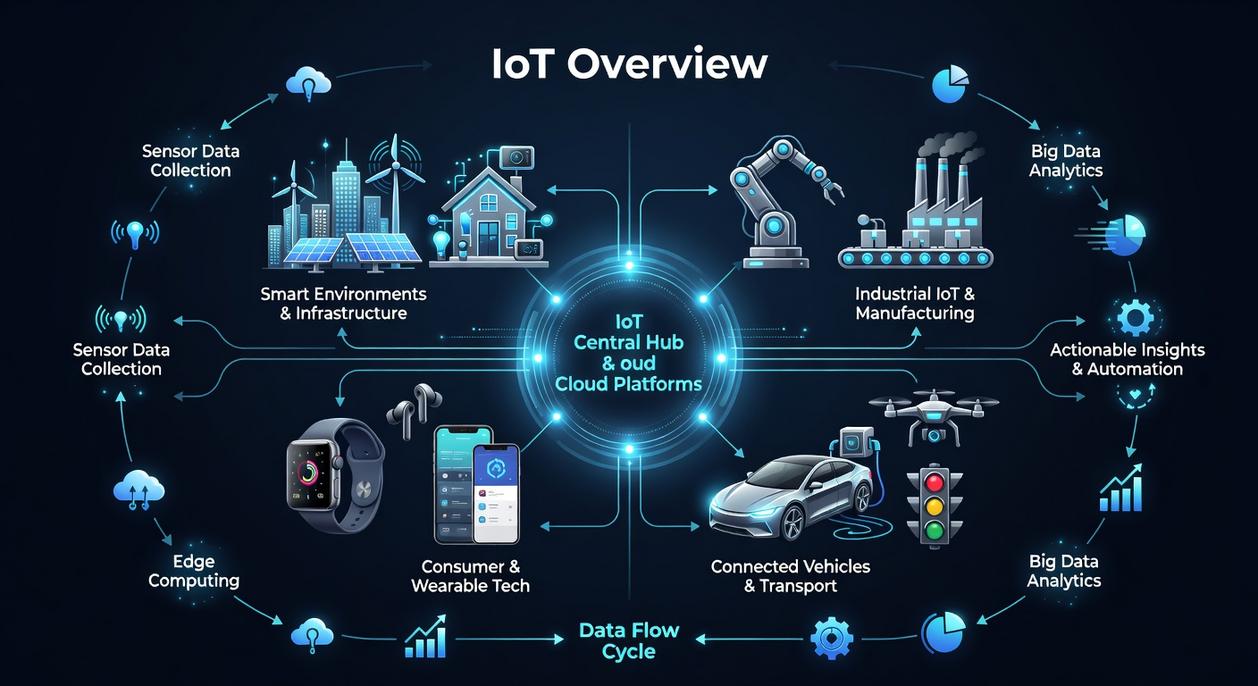
An effective internet of things overview starts with impact. Today, IoT (Internet of Things, meaning interconnected devices that collect and exchange data) is no longer experimental—it’s measurable, scalable, and transforming entire sectors.
Industrial IoT (IIoT) & Smart Manufacturing
First, consider predictive maintenance. By using connected sensors to monitor vibration, temperature, and pressure, manufacturers can detect equipment failures before they happen. According to McKinsey, predictive maintenance can reduce machine downtime by up to 50% and cut maintenance costs by 10–40%. In practice, companies like Siemens deploy sensor-driven analytics to avoid costly production halts.
Moreover, real-time supply chain tracking improves inventory accuracy and delivery timelines. DHL reports that IoT-enabled tracking can improve operational efficiency by 15%. At the same time, wearable safety devices alert workers to hazardous conditions, lowering workplace injuries (a major cost driver in heavy industry).
Smart Cities & Public Services
Meanwhile, cities are using IoT to ease congestion and cut emissions. Barcelona’s smart traffic systems reduced travel time by 21% by dynamically adjusting signal timing. Similarly, smart waste bins equipped with fill-level sensors enable optimized collection routes, reducing fuel consumption and operational costs.
In addition, connected infrastructure sensors detect structural weaknesses in bridges and roads. Early detection prevents catastrophic failures—and expensive emergency repairs.
Healthcare & Remote Patient Monitoring
In healthcare, wearable IoT devices track heart rate, oxygen saturation, and glucose levels in real time. A study published in NPJ Digital Medicine found remote monitoring reduced hospital readmissions for chronic patients by nearly 20%. Alerts notify caregivers instantly, enabling faster intervention and remote consultations.
Agriculture & Precision Farming
Finally, precision agriculture uses soil moisture sensors, drones, and automated irrigation systems to optimize water usage. The FAO estimates smart irrigation can reduce water consumption by up to 30% while improving yields.
However, critics argue IoT increases cybersecurity risks. That concern is valid. As explored in cybersecurity threat landscape an expert analysis, expanding device networks requires stronger encryption, segmentation, and monitoring to ensure resilience.
Ultimately, the data is clear: when implemented strategically, IoT delivers measurable efficiency, safety, and sustainability gains across industries.
The Critical Role of Security and Data Encryption
With billions of connected devices online, the attack surface for cyber threats has exploded. Every smart thermostat, wearable, and industrial sensor adds another entry point. The upside? When secured properly, these devices deliver efficiency, automation, and real-time insight. The risk? Data breaches that erode trust and cost billions annually (IBM reports the average breach cost reached $4.45 million in 2023).
Device-level security is your first line of defense. Secure boot ensures a device only runs trusted software. Regular firmware updates patch vulnerabilities before attackers exploit them. Physical tamper protection prevents bad actors from extracting sensitive data directly from hardware. (Yes, hackers still use screwdrivers.) The benefit is simple: fewer weak links in your ecosystem.
Network protection matters just as much. End-to-end encryption (E2EE)—a method that ensures only the sender and intended recipient can read data—protects information in transit and at rest. Without it, intercepted data is basically readable text. With it, it’s useless gibberish to outsiders.
Best practices for stronger deployments:
- Implement strong authentication (multi-factor whenever possible)
- Segment networks to contain breaches
- Conduct regular security audits
In any internet of things overview, one truth stands out: better security means safer data, stronger customer confidence, and long-term operational resilience.
Putting It All Together: From Concept to Connected Future
This internet of things overview makes one thing clear: IoT isn’t a single gadget or app. It’s an ecosystem—meaning a connected system of sensors (data collectors), networks (data movers), software (data processors), and interfaces (data presenters)—that turns physical input into digital action. In other words, your thermostat isn’t “smart” on its own; it’s smart because it talks, analyzes, and responds.
Turning Understanding into Action
However, complexity is often the biggest roadblock. So instead of seeing IoT as a mysterious black box, break it into four practical pillars:
- Devices: What is collecting the data?
- Connectivity: How is the data transmitted?
- Processing: Where is it analyzed?
- Action: What automatic response follows?
For example, start at home: install a smart plug to monitor energy use. Next, review the app’s data weekly. Then, automate shutoffs during peak hours.
Pro tip: Always enable encryption and update firmware regularly (security is the quiet hero here).
Ultimately, once you think in systems, you can spot automation opportunities everywhere—from office lighting to community traffic flow.
Turn Insight Into Implementation
You came here for clarity, and now you have a practical understanding of how connected systems, AI integration, encryption protocols, and device optimization all work together in today’s evolving tech landscape — including a clear internet of things overview that ties it all together.
The real challenge isn’t information. It’s keeping up with rapid innovation while ensuring your systems stay secure, efficient, and future-ready. Falling behind on core computing concepts or emerging AI capabilities can cost time, performance, and competitive edge.
Now it’s time to act. Start applying these insights by auditing your current infrastructure, strengthening your data encryption standards, and optimizing device performance for scalability. If you’re serious about staying ahead, explore deeper technical resources and proven optimization frameworks trusted by thousands of forward-thinking tech professionals.
Don’t just understand innovation — implement it. Take the next step today and turn knowledge into measurable performance gains.
 Founder & Chief Visionary Officer (CVO)
Selviana Vaelvessa writes the kind of device optimization techniques content that people actually send to each other. Not because it's flashy or controversial, but because it's the sort of thing where you read it and immediately think of three people who need to see it. Selviana has a talent for identifying the questions that a lot of people have but haven't quite figured out how to articulate yet — and then answering them properly.
They covers a lot of ground: Device Optimization Techniques, AI and Machine Learning Ideas, Data Encryption and Network Protocols, and plenty of adjacent territory that doesn't always get treated with the same seriousness. The consistency across all of it is a certain kind of respect for the reader. Selviana doesn't assume people are stupid, and they doesn't assume they know everything either. They writes for someone who is genuinely trying to figure something out — because that's usually who's actually reading. That assumption shapes everything from how they structures an explanation to how much background they includes before getting to the point.
Beyond the practical stuff, there's something in Selviana's writing that reflects a real investment in the subject — not performed enthusiasm, but the kind of sustained interest that produces insight over time. They has been paying attention to device optimization techniques long enough that they notices things a more casual observer would miss. That depth shows up in the work in ways that are hard to fake.
Founder & Chief Visionary Officer (CVO)
Selviana Vaelvessa writes the kind of device optimization techniques content that people actually send to each other. Not because it's flashy or controversial, but because it's the sort of thing where you read it and immediately think of three people who need to see it. Selviana has a talent for identifying the questions that a lot of people have but haven't quite figured out how to articulate yet — and then answering them properly.
They covers a lot of ground: Device Optimization Techniques, AI and Machine Learning Ideas, Data Encryption and Network Protocols, and plenty of adjacent territory that doesn't always get treated with the same seriousness. The consistency across all of it is a certain kind of respect for the reader. Selviana doesn't assume people are stupid, and they doesn't assume they know everything either. They writes for someone who is genuinely trying to figure something out — because that's usually who's actually reading. That assumption shapes everything from how they structures an explanation to how much background they includes before getting to the point.
Beyond the practical stuff, there's something in Selviana's writing that reflects a real investment in the subject — not performed enthusiasm, but the kind of sustained interest that produces insight over time. They has been paying attention to device optimization techniques long enough that they notices things a more casual observer would miss. That depth shows up in the work in ways that are hard to fake.