
If you’ve been searching for quantum computing basics explained, you’re likely looking for a clear, practical breakdown of what quantum computing is, how it works, and why it matters for the future of technology. The topic is often surrounded by complex math and abstract theory, making it difficult to separate real-world applications from hype. This article cuts through that complexity to give you a structured, easy-to-follow introduction to core principles like qubits, superposition, and entanglement—without assuming an advanced physics background.
Our goal is to bridge foundational computing concepts with emerging quantum innovations, helping you understand not just the “what,” but the “why” behind this transformative field. Drawing on established research, current technological developments, and expert-backed explanations from the broader scientific community, this guide provides accurate, up-to-date insights you can rely on. By the end, you’ll have a solid grasp of how quantum computing differs from classical systems and where it’s headed next.
Classical computers speak in bits—0s and 1s—like light switches flipping on or off. I remember staring at my first programming screen, believing that was the peak of possibility. Then I encountered quantum computing basics explained, and everything shifted.
Quantum computing sounds intimidating, but it doesn’t require a physics Ph.D. At its heart are three ideas.
The Three Pillars
Superposition means a quantum bit, or qubit, can be 0 and 1 simultaneously. Entanglement links qubits so one instantly affects another. Interference amplifies correct outcomes while canceling errors.
Skeptics call it hype. Maybe. But the math—and early breakthroughs—suggest otherwise. Real change.
The Quantum Bit (Qubit): The Heart of Quantum Power)
First, let’s ground this in something familiar. A classical bit is like a light switch: it’s either off (0) or on (1). Every email, photo, or video you’ve ever sent is built from long strings of these simple 0s and 1s. Straightforward, reliable—and limited.
Now, enter the qubit. Unlike a classical bit, a qubit can exist as 0, 1, or a combination of both at the same time. This property is called superposition—the ability of a quantum system to occupy multiple states simultaneously. Think of a spinning coin: while it’s spinning, it’s neither strictly heads nor tails. Only when it lands do you see one outcome. Until then, it holds a spectrum of possibilities.
Here’s a quick comparison:
| Feature | Classical Bit | Qubit |
|---|---|---|
| Possible States | 0 or 1 |
0, 1, or both |
| Behavior | Deterministic| Probabilistic |
| Growth Pattern | Linear | Exponential |
So why does this matter? Because power scales fast. Two classical bits represent one of four combinations at a time. Two qubits, however, can represent all four states simultaneously. Add a third qubit? You jump to eight states at once. This doubling continues exponentially.
For practical understanding, try mapping small logic problems as state combinations—it’s a helpful exercise when learning quantum computing basics explained in the section once exactly as it is given. In short, superposition is the engine behind quantum’s explosive potential (and yes, it’s as wild as it sounds).
Entanglement: The “Spooky” Connection That Amplifies Power
Entanglement is one of the most fascinating—and confusing—ideas in quantum physics. In simple terms, entanglement is a deep connection between two or more qubits (a qubit is the basic unit of quantum information, similar to a classical bit but able to exist in multiple states at once). When qubits are entangled, the state of one instantly influences the state of the other, no matter how far apart they are. Albert Einstein famously called this “spooky action at a distance” (and honestly, it still feels that way).
To make this clearer, imagine a pair of magic gloves. You place one glove in each of two separate boxes and ship them to opposite sides of the world. When you open one box and see a left-handed glove, you instantly know the other box contains the right-handed glove. Entangled qubits behave similarly—but with far more complexity.
Now, here’s why this matters. Because entangled qubits are correlated (meaning their states are mathematically linked), they can perform coordinated calculations that classical bits simply cannot. Instead of working independently, they act as a unified computational system. This is where quantum computing basics explained in the section start to click.
Some argue entanglement is too fragile to be practical—and they’re partly right; it’s delicate. However, advances in error correction and isolation techniques continue to improve stability. As a result, entanglement transforms individual qubits into a massively powerful problem-solving network (think Avengers, but subatomic).
Putting It to Work: Interference and Measurement
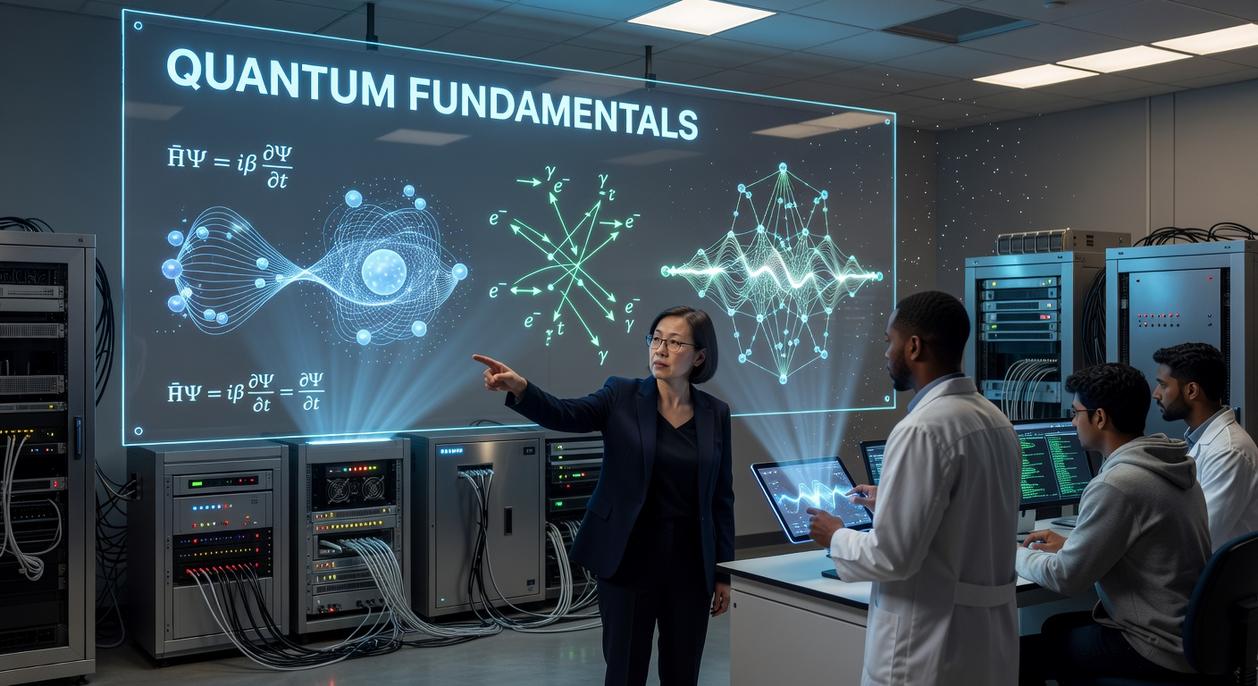
When people first hear about quantum algorithms, they often imagine raw computing power magically spitting out answers. I think that framing misses the real beauty: quantum interference—the process where probability waves combine, either reinforcing or canceling each other.
In simple terms, a qubit (the quantum version of a classical bit) can exist in a superposition, meaning it represents both 0 and 1 at the same time. But here’s the twist: quantum algorithms carefully manipulate these overlapping states so that wrong answers interfere destructively while the correct answer interferes constructively. The result? The right outcome becomes far more likely when measured.
If that sounds abstract, consider noise-canceling headphones. They generate sound waves that destructively interfere with ambient noise, effectively silencing it. Quantum systems do something similar—except instead of canceling chatter on a plane, they cancel incorrect computational paths.
Now, measurement is where things get serious. The moment we measure a qubit, its superposition collapses into a definite 0 or 1. Some argue this makes quantum systems fragile—and they’re not wrong. However, the brilliance of a well-designed algorithm is that it engineers interference so the collapse yields the correct answer with high probability.
Understanding this interplay is central to quantum computing basics explained in the section, much like grasping signal flow in how 5g networks actually work behind the scenes.
Real-World Impact: Why Quantum Matters for Encryption, AI, and Optimization
Quantum computing basics explained often sound abstract, but the real-world stakes are enormous. Take encryption. Today’s RSA standard relies on the difficulty of factoring large numbers. Classical computers would need centuries; a sufficiently powerful quantum machine running Shor’s algorithm could do it dramatically faster (Shor, 1994). Some argue large-scale quantum systems are decades away, so why worry? I disagree. Data harvested today can be decrypted later. That’s why quantum-resistant cryptography—algorithms designed to withstand quantum attacks—isn’t optional, it’s urgent (NIST, 2022).
In AI, quantum systems can evaluate many possibilities simultaneously, potentially accelerating model training and optimization. Critics say classical GPUs are improving fast enough. Maybe—but quantum could redefine “fast enough.”
- Drug discovery and materials science may benefit most, as quantum simulations model molecular interactions beyond classical limits.
Personally, I think finance and logistics optimization will feel the disruption sooner than we expect.
The Quantum Future: From Abstract Theory to Practical Revolution
Let’s CLARIFY the essentials. Qubits use superposition (being in multiple states at once), entanglement links qubits so their states correlate instantly, and interference amplifies correct answers while canceling wrong ones. That’s the engine behind quantum computing basics explained in the section.
If that once sounded like sci‑fi, you now hold a functional grasp of how this technology works (yes, it’s weird—but so was Wi‑Fi once).
Importantly, quantum machines won’t replace classical computers. They’re SPECIALIZED tools built to tackle problems—like complex simulations and cryptography—we once thought IMPOSSIBLE.
You came here to get quantum computing basics explained in a way that actually makes sense—and now you have a clear foundation to build on. From understanding qubits and superposition to seeing how quantum systems differ from classical machines, you’re no longer stuck trying to decode complex jargon.
The reality is that quantum computing can feel overwhelming. Rapid innovation, unfamiliar terminology, and constant breakthroughs make it hard to know where to focus. But with the right guidance, these concepts become not just understandable—but actionable.
Quantum technology is advancing fast, and those who grasp the fundamentals today will be better prepared for tomorrow’s breakthroughs in AI, encryption, and high-performance computing.
Take the Next Step in Mastering Quantum Technology
Don’t let confusion slow you down while the tech world accelerates. Get deeper insights, practical breakdowns, and expert-driven guidance trusted by thousands of forward-thinking readers. Explore more advanced resources now and start building your quantum-ready knowledge base today.
 Director of Machine Learning & AI Strategy
Jennifer Shayadien has opinions about core computing concepts. Informed ones, backed by real experience — but opinions nonetheless, and they doesn't try to disguise them as neutral observation. They thinks a lot of what gets written about Core Computing Concepts, Device Optimization Techniques, Data Encryption and Network Protocols is either too cautious to be useful or too confident to be credible, and they's work tends to sit deliberately in the space between those two failure modes.
Reading Jennifer's pieces, you get the sense of someone who has thought about this stuff seriously and arrived at actual conclusions — not just collected a range of perspectives and declined to pick one. That can be uncomfortable when they lands on something you disagree with. It's also why the writing is worth engaging with. Jennifer isn't interested in telling people what they want to hear. They is interested in telling them what they actually thinks, with enough reasoning behind it that you can push back if you want to. That kind of intellectual honesty is rarer than it should be.
What Jennifer is best at is the moment when a familiar topic reveals something unexpected — when the conventional wisdom turns out to be slightly off, or when a small shift in framing changes everything. They finds those moments consistently, which is why they's work tends to generate real discussion rather than just passive agreement.
Director of Machine Learning & AI Strategy
Jennifer Shayadien has opinions about core computing concepts. Informed ones, backed by real experience — but opinions nonetheless, and they doesn't try to disguise them as neutral observation. They thinks a lot of what gets written about Core Computing Concepts, Device Optimization Techniques, Data Encryption and Network Protocols is either too cautious to be useful or too confident to be credible, and they's work tends to sit deliberately in the space between those two failure modes.
Reading Jennifer's pieces, you get the sense of someone who has thought about this stuff seriously and arrived at actual conclusions — not just collected a range of perspectives and declined to pick one. That can be uncomfortable when they lands on something you disagree with. It's also why the writing is worth engaging with. Jennifer isn't interested in telling people what they want to hear. They is interested in telling them what they actually thinks, with enough reasoning behind it that you can push back if you want to. That kind of intellectual honesty is rarer than it should be.
What Jennifer is best at is the moment when a familiar topic reveals something unexpected — when the conventional wisdom turns out to be slightly off, or when a small shift in framing changes everything. They finds those moments consistently, which is why they's work tends to generate real discussion rather than just passive agreement.